
Your book is ready for its next life: something a reader notices, picks up and wants to spend time with. If you are hiring a studio for the cover and interior, choose one that can make both experiences belong to the same book. The portfolio should make you want to keep looking. The proposal should tell you how that level of care will carry through your own project.
How do you choose the right book cover designer?
Shortlist designers whose finished work suits your readership, compare their visual judgment, then confirm the process, availability and scope. If you also need the inside of the book designed, evaluate interior samples separately. A strong match is more useful than a long list of names.
Start with the reader you want to reach. A warm, illustrated memoir, a sharp business book and a commercial thriller can all look beautifully made, but they should not make the same visual promise. Ask yourself which portfolio pieces belong near your book’s intended shelf, and why.
Look for a clear idea rather than simply an attractive image. Does the typography belong with the artwork? Is there a focal point? Does the design suggest the right reading experience without trying to summarize every chapter? Paying for custom design is partly paying for those choices, including knowing what to leave out.
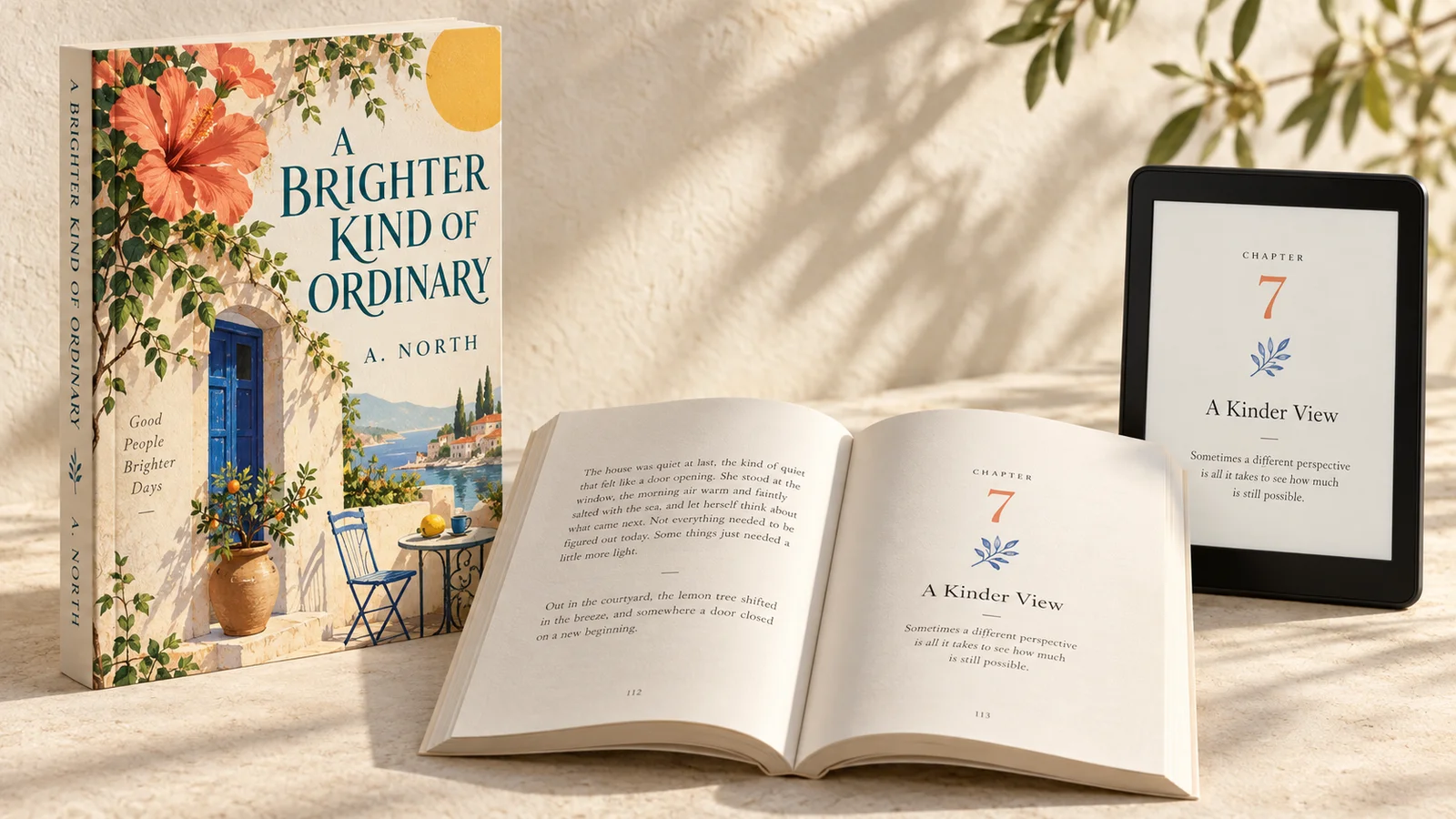
The example above uses a sunlit doorway, coral flowers and an open composition to suggest warmth and possibility. Inside, the smaller botanical detail and coral chapter number carry that character into a quieter reading environment. The cover invites attention; the interior gives the text room. They are related without repeating the entire illustration on every page.
That is the kind of connection to discuss with a studio. Browse finished book-cover projects, select two or three relevant examples and explain what attracts you. You are choosing a designer’s judgment, not ordering a copy of another author’s cover.
Look for consistency across the portfolio
A single striking cover can draw you in. Look at several relevant projects before making a decision: typography, image finishing and visual clarity should feel considered across the work, not just on the home-page hero. Compare books aimed at similar readers rather than ranking unrelated genres against each other.
Then ask who will design your book. A studio may work as a team or assign a specialist; an independent designer may handle the whole project. Neither arrangement is automatically better. What matters is whether the examples you like represent the person and service you are booking.
Read client feedback for what it says about communication and the actual collaboration. A review can help you understand the experience of working together; a star rating does not replace looking at the design. Be cautious about treating a bestselling title as proof that its cover caused the sales.
Judge the interior as carefully as the cover
A cover portfolio tells you about image-making and typography. It does not show whether someone can handle a long chapter, a complicated table or the rhythm of a nonfiction book. When shortlisting a studio, ask to see interior work relevant to your manuscript as well as covers in the right genre.
For a novel, look beyond the chapter opener. Read a normal spread: does the text feel comfortable, are the margins balanced, and are scene breaks easy to understand? For a business book, look at heading levels, lists, quotations and tables. For an illustrated book, ask how captions and images behave together. A beautiful empty title page answers none of those questions.
Before the entire manuscript is laid out, agree on a representative sample as a milestone in the paid project. Choose pages that include the hardest recurring material. A sample with a chapter opening, ordinary text and a difficult table is more useful than three decorative pages.
The page you approve should represent the book you are buying, including the parts that are difficult to typeset.
Also discuss how the ebook will be reviewed. A screenshot of a print spread is not evidence that the digital edition reads well. Ask to see its navigation and how text behaves when a reader changes the display settings, where that format supports it.
What should a book cover and interior design package include?
A useful proposal names the editions, the design work and the final files. “Cover included” might mean a front image for an ebook or a complete paperback wrap. “Interior included” might mean a print layout, an ebook edition, or both. Those differences matter more than the package name.
For a paperback, Amazon KDP requires separate manuscript and cover files: the inside of the book and its front, spine and back. That is a good starting point for defining the delivery, even when one studio handles everything. KDP: Format Your Paperback.
| Part of the job | What to have confirmed |
|---|---|
| Cover design | Creative approach, concept allowance and whether the price covers the ebook front, paperback wrap or both. |
| Print interior | Trim size, page allowance, chapter design and treatment of tables, images, notes and other complex pages. |
| Ebook interior | Whether a separate ebook file is included, its layout approach, navigation and the devices or preview tools used to check it. |
| Additional editions | Hardcover, another print supplier, a second language or a future volume: list each separately. |
| Corrections and handoff | Revision rounds, manuscript changes, technical corrections, editable files and any upload assistance. |
If you only need the outside designed, start with book cover design. If the manuscript also needs a finished reading layout, compare cover and interior design packages. Buying a complete package makes sense when its actual scope matches your launch.
Cover and interior together: who coordinates the final page count?
Working with one studio can simplify communication. Separate specialists can also work well, provided someone owns the handoff. The dependency to settle is the final print cover: its spine must match the selected production specifications and finished interior.
Establish the visual language while the layout is still manageable.
Resolve text changes before fixing the dimensions of the print wrap.
Use the selected printer’s specifications and review the finished files.
You do not have to wait for the last page to be typeset before discussing cover direction. But final production needs coordination. Ask who sends the approved page count to the cover designer, who checks the cover template, and what happens if you add material after that handoff.
KDP provides a cover calculator and templates using your book’s production choices. For another printer, use that printer’s requirements. A quote saying “print-ready” should identify the intended edition and supplier rather than leave you to discover the difference at upload.
Compare the amount of work, not just the number of pages
A text-only novel and a nonfiction book with sidebars, tables and image captions can have the same page count and very different design needs. Send a representative manuscript sample when requesting quotes. Mention repeated elements, unusual layouts and how many images need placement or preparation.
Ask how a page allowance is measured. Is it based on manuscript pages, words or the final typeset book? If the package covers a fixed number of finished pages, find out how additional pages are priced before choosing a trim size or committing to a schedule.
For cover-only market comparisons, use our separate book cover design cost guide. For a combined project, put the cover, print interior, ebook and any additional editions on separate lines in each proposal. Then compare the total for the same work. A cheaper headline price may simply omit an edition you need.
Decide what can still change after design begins
Tell the designer honestly whether the manuscript is edited and ready for layout. Replacing a paragraph is different from adding a chapter. Changes that move text through the book can affect pagination, the contents page and the print wrap.
Agree on two things: how you will submit corrections, and which changes count as additional work. A consolidated list from one decision-maker is easier to act on than comments spread across email, marked PDFs and messages from several readers.
- Design revisions: changes to the agreed sample, typography, cover direction or layout treatment.
- Author changes: new text, replacement images, altered chapter order or revised back-cover copy.
- Technical corrections: fixing a delivered file that does not meet the agreed specification. Ask how these are handled.
Have the studio distinguish these in writing. Also confirm whether editing, proofreading, indexing, image permissions, ISBN setup or account uploads are included. They are separate tasks that the phrase “complete design” does not settle.
Know what you will receive at the end
Request a delivery list by edition, including the cover and interior files, any agreed editable source files and the scope of future changes. Discuss fonts and licensed imagery if you expect another designer to make later adaptations; access to a source file does not by itself settle every asset’s permitted use.
Reserve time to review the upload preview and, for print, a physical proof before your planned launch. Confirm who reviews technical feedback from the platform and whether another proof cycle fits the schedule. A design delivery date is not the same as your book being available for readers.
Send a brief that gets you a comparable quote
You do not need to arrive with a finished design. You do need to describe the book and the production task. This is enough to begin a useful conversation:
- Genre, intended reader, approximate word count and manuscript status.
- Launch editions: ebook, paperback, hardcover, and intended publishing platforms.
- Representative pages, plus the number and type of images, tables or other complex elements.
- Cover references with a sentence explaining what fits your readership.
- Your target launch date, budget range and who gives final approval.
At COLONFILM, David and Flor work on complete book design as well as standalone covers. Check the listed package allowances against your manuscript, then ask about anything outside them. For a project with a substantial interior, that scope conversation is the sensible place to spend time before placing an order.
YOUR MANUSCRIPT. A DEFINED SCOPE.
Let’s work out the right book package.
Tell us your genre, word count, editions, budget and launch date. We can discuss the cover and interior as one project.
Discuss your book project →Compare complete book packagesQuestions before you book
Can I hire one designer for the cover and another for the interior?
Yes. Check both portfolios and agree who coordinates trim size, final pagination and the print cover template. The handoff needs an owner even when the creative work is split.
Does a full print cover include interior formatting?
Do not assume so. “Full cover” usually describes the outside: back, spine and front. Ask for interior design and ebook production to be explicitly listed if you need them.
Should I finish editing before booking?
You can discuss availability and scope earlier. Tell the studio what is still changing, and agree when the manuscript must be ready for layout. This protects the production schedule from avoidable rework.