
Most articles about cover pricing quote a range so wide it tells you nothing. This one compares like for like — e-book against e-book, print wrap against print wrap, illustration against illustration — and publishes our own numbers inside that comparison, so you can judge them against everyone else's.
The short answer
In 2026, a professional custom book cover costs roughly $180 to $1,250, and where you land inside that depends almost entirely on three things we will break down below.
Two useful reference points, both public:
- Marketplace rates. Reedsy reports an average of $880 across more than 9,600 cover projects, with most falling between $625 and $1,250. These are marketplace project statistics, not a universal price list; project scope and designer experience vary. Source: Reedsy's 2026 cost report.
- Studio rates. For a published package comparison, MIBLART lists an e-book cover at $220 and an e-book plus print-ready cover at $270.
Prices checked September 2026; confirm the provider's current inclusions before ordering. Those two numbers are not measuring the same thing, which is exactly the problem with most price articles. An $880 average that mixes e-book-only jobs with fully illustrated print wraps is not a price — it is an average of different products. So let us separate them.
What you are actually paying for
Three levers move the price. Everything else is noise.
1. Where the image comes from
This is the single biggest factor, and it explains most of the gap between a $220 cover and a $900 one.
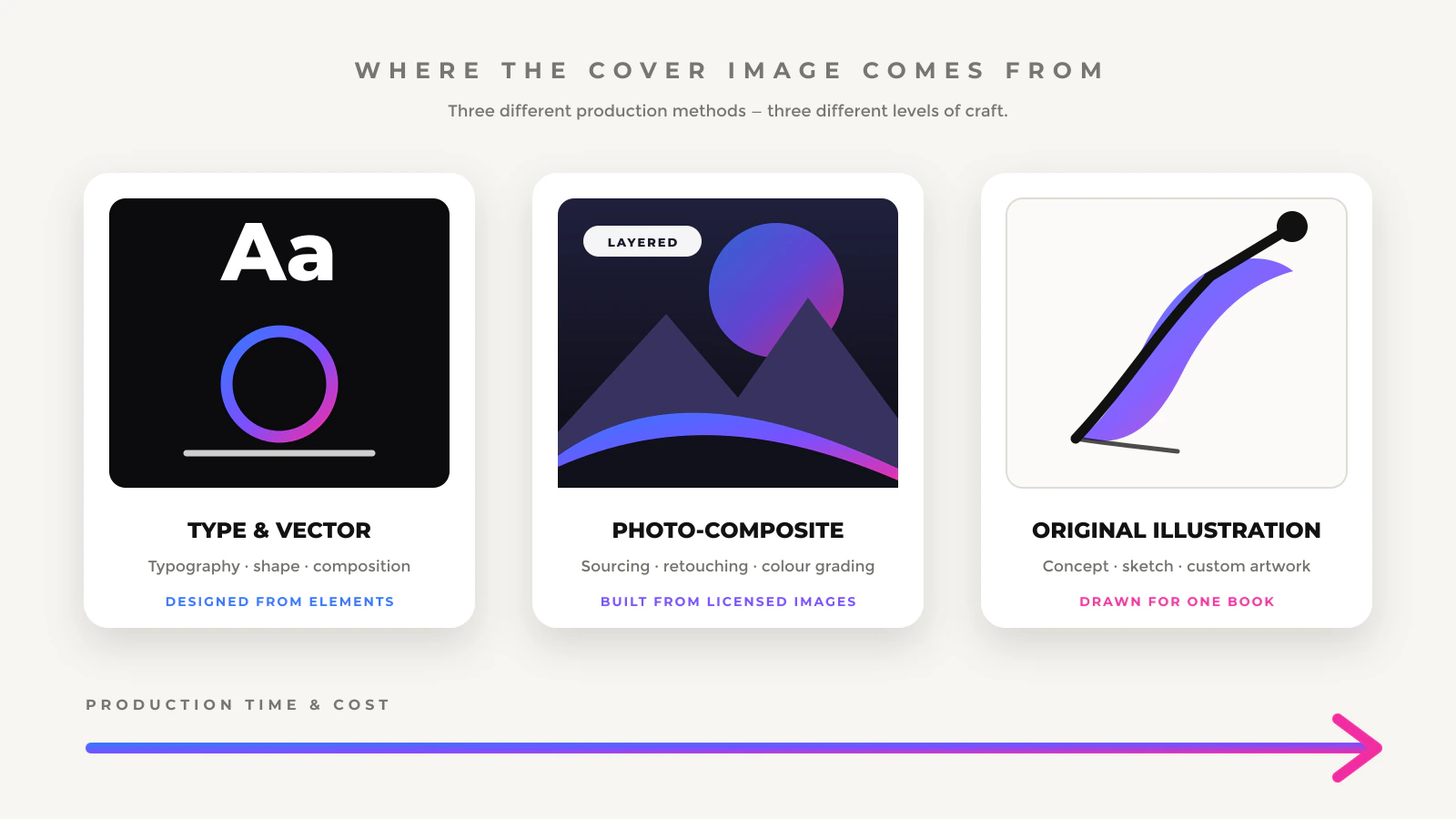
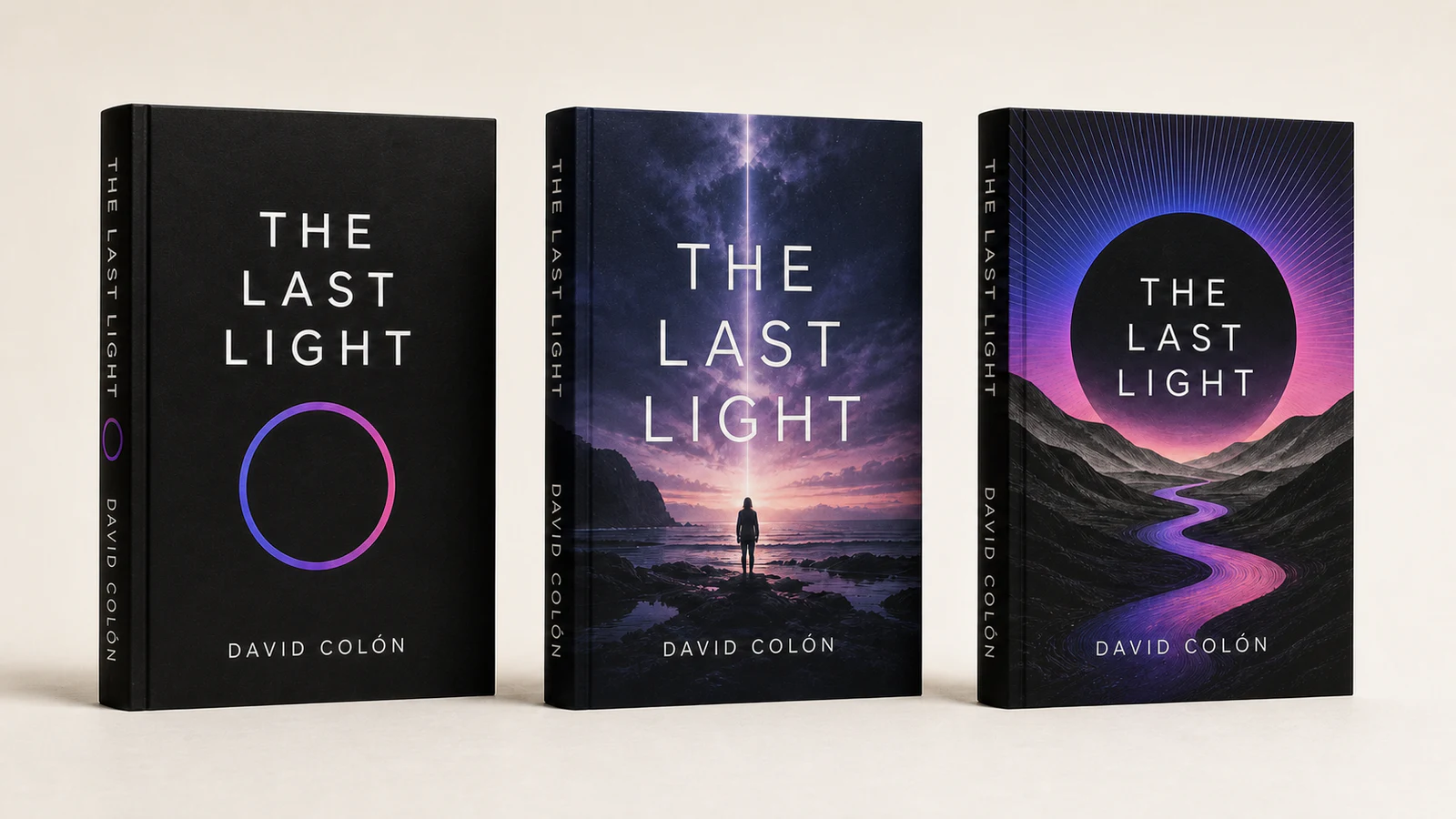
- Typographic and vector work. No photography, no illustration — type, shape and composition doing the work. Done badly it looks unfinished. Done well it is the sharpest thing on the shelf, which is why so much literary fiction and serious nonfiction uses it. This is the most affordable route, and it is a legitimate choice, not a budget compromise.
- Photo-composite covers. The designer licenses stock images and blends, retouches and colour-grades them into something that did not exist before. You are paying for sourcing judgement, compositing craft, and the licences themselves. This is the standard look for thrillers, drama and commercial fiction.
- Original illustration. Someone concepts, sketches and renders artwork from nothing, for your book only. Fantasy, sci-fi and children's books often need it because the image does not exist in any photo library. It is the most expensive tier, and it should be.
Watch out for one thing here: “illustrated” is used loosely across the industry. Some studios price simple vector-style artwork and fully rendered painted illustration under the same word, at very different rates. If you are quoted a low price for an “illustrated” cover, ask to see finished examples in the exact style you are buying — not the studio's best work in a different style.
2. How much of the cover you need
An e-book cover is one rectangle. A print cover is a wrap: back cover, spine and front, sized to your exact page count and paper stock. The spine width changes with every page you add or remove, which is why print always costs more than digital.
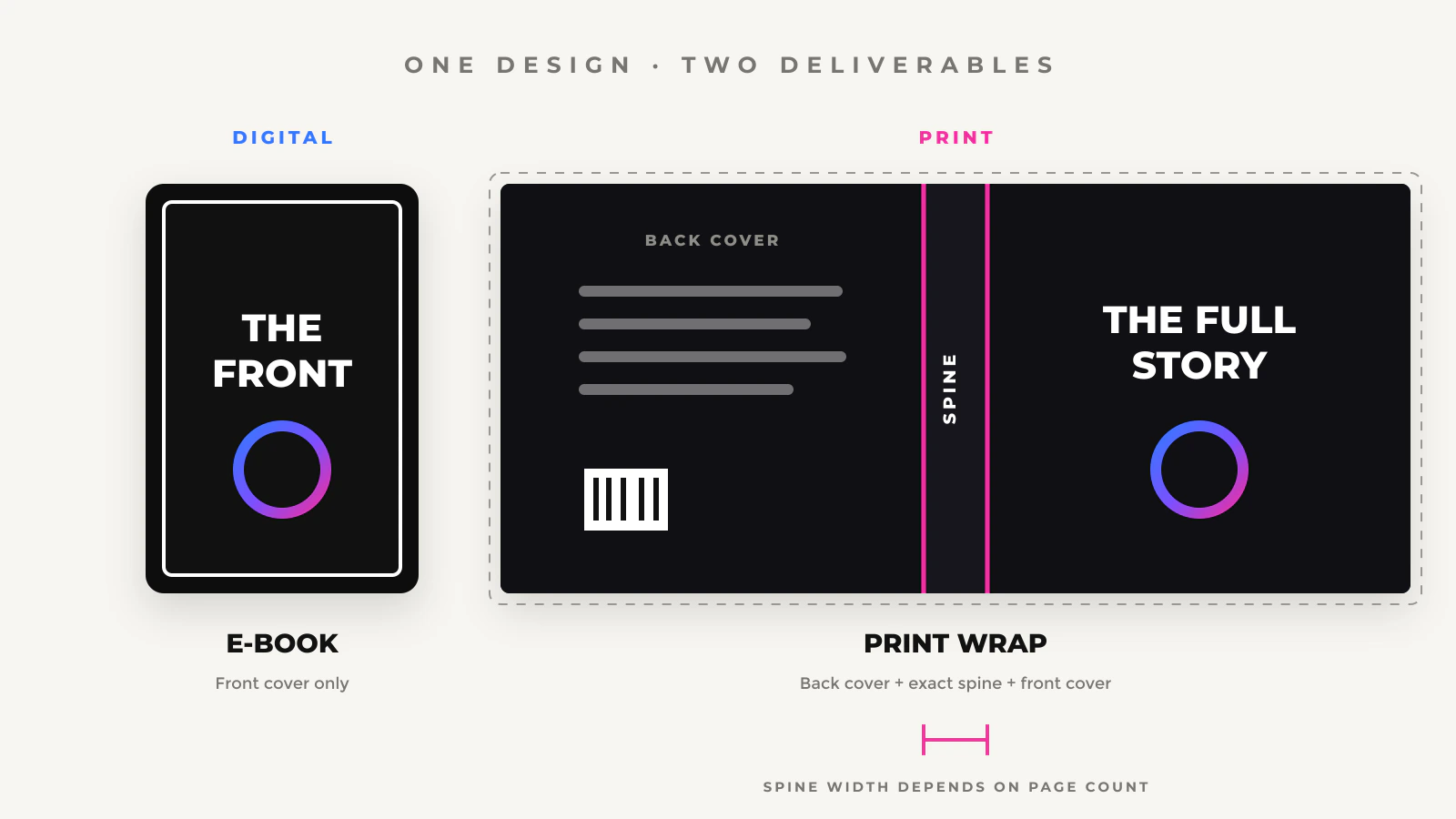
Plenty of authors buy a full print wrap when they are only launching on Kindle. If print is six months away, buy the e-book cover now and upgrade later — a good designer keeps your source files and extends the artwork rather than starting over. If you do need print, our book page calculator works out your spine width for free.
3. What you take away
Two quotes can cover identical design work and differ entirely on files and rights. Check three things:
- Print-ready files. A JPG is not a print cover. You want the correct format, bleed and resolution for KDP or IngramSpark.
- The editable source file. Usually a layered PSD. It can make future adaptations easier, but its inclusion and editing rights must be agreed. Without it, ask the original designer about changes and file retention; a complete rebuild is not always necessary.
- Licensing. Who holds the stock licences, and what happens to them when the project ends.
What each price band really gets you
Under $150
Premade covers and templates. Nothing shameful here — a good premade beats a bad custom cover every time. Check whether the completed design is sold exclusively and how much customization is included. Individual stock assets can be licensed to other designers even when the assembled cover is exclusive. Fine for a first novella, risky for a series you intend to build a brand on.
$150 – $350
Entry-level custom work. Realistically an e-book front cover — typographic, or built from a small number of licensed images — with one concept and a couple of revision rounds. Genuinely good value if your genre's bestsellers are photographic or type-led.
$350 – $700
A possible budget for a more complete package, depending on the designer and scope. A full print wrap, more source imagery, print-ready files for both KDP and IngramSpark, and usually the editable source file. Check each deliverable rather than assuming a price band guarantees it.
$700 – $1,250
Fully rendered original illustration, complex composites, or series branding across several titles. Worth it when the artwork genuinely has to be made rather than found. Compare individual quotes rather than assuming all marketplace projects have the same scope.
Above $1,250
Agency work, well-known cover artists, or traditional publishing budgets. Sometimes justified. A higher price can reflect experience, rights, scope or overhead; price alone cannot tell you which. Ask what you get that the band below does not include.
Why we cap revisions — and why “unlimited” is worth a second look
Unlimited revisions is a common selling point, and on the surface it sounds like generosity. In practice it is usually insurance against a weak brief.
Here is the uncomfortable truth after more than a decade of doing this: if a cover needs eight rounds of revision, the design was never the problem. The problem is that nobody established what the book actually needed before the first pixel was drawn. Revisions are then spent hunting for a direction, which is the most expensive possible way to find one.
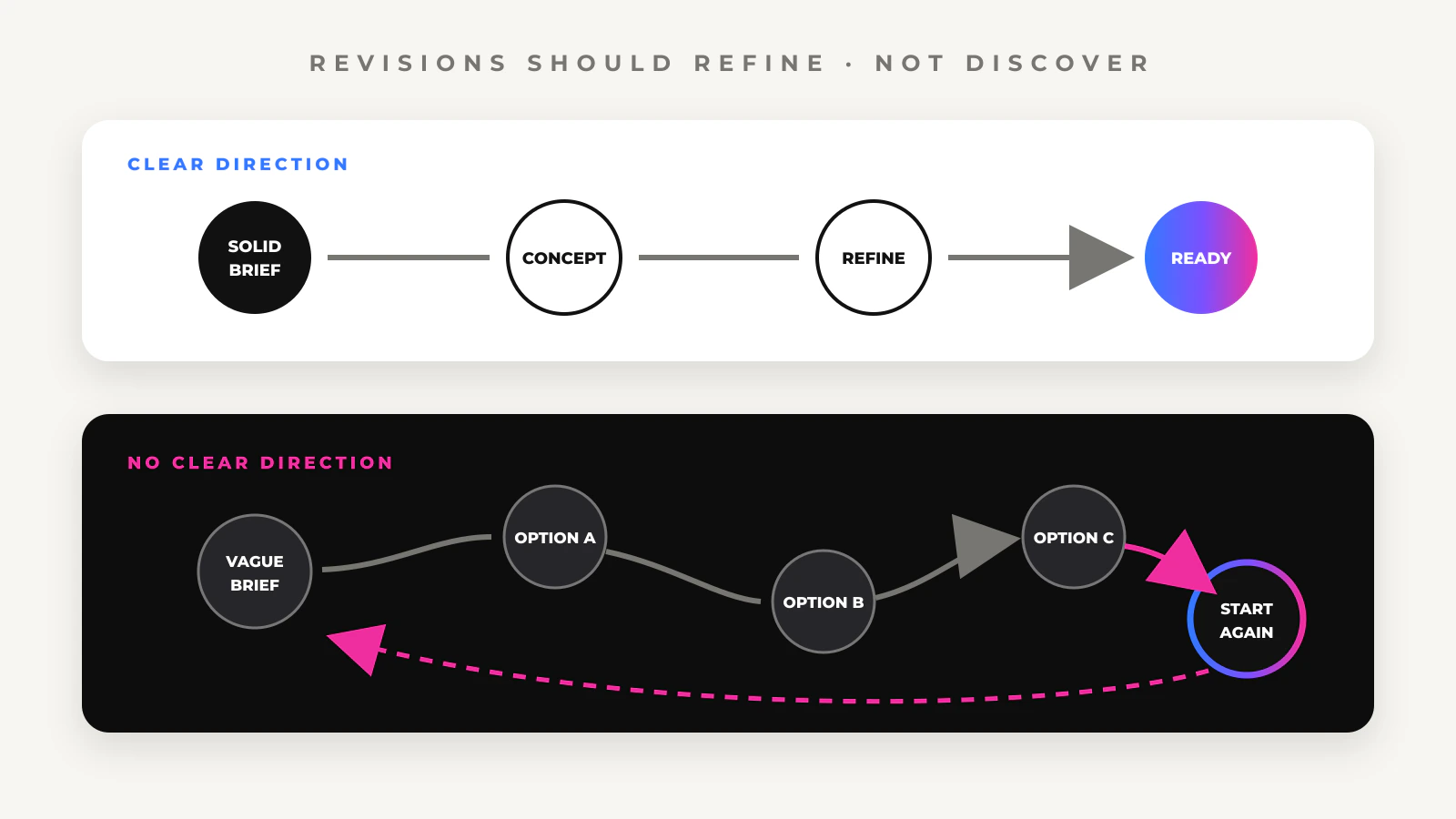
Revisions should refine, not discover. Adjusting the weight of the typography, warming the colour, tightening the crop, testing the title at thumbnail size — that is what a revision round is for. “Let's try something completely different” is not a revision. It is a restart, and it means the conversation that should have happened at the beginning is happening at the end.
A defined number of rounds focuses both sides. It puts the real discussion where it is cheap — before the work starts — instead of where it is expensive. And it protects the thing you are actually paying for: a professional making decisions, rather than executing a committee.
You should absolutely have an opinion. It is your book, you know your readers, and no designer should ignore that. But there is a difference between telling a designer what the book is and art-directing them through it. Choosing a restaurant with care works better than sending the dish back five times. The decision that matters most is which professional you hire — everything after that should be refinement.
To be fair to the other side: unlimited revisions genuinely does protect a buyer who is not confident judging design, and some authors want that safety net. That is a reasonable preference. We would just rather remove the need for it.
Which is why we give the upfront work away for free. Our cover design brief template is the set of questions a professional actually needs answered, and the cover concept wizard helps you work out your visual direction before you hire anyone. Use them with us or with any designer — the brief is what determines whether the cover works, no matter who makes it.
The costs nobody puts in the price list
This is where budgets break. Ask about all five before you accept a quote:
- Rush delivery. Compressing a two-week job into two days costs real money — anywhere from $60 to $350 depending on style. Illustration cannot be rushed as cheaply as compositing, because the hours are the product.
- Complexity add-ons. Some studios charge per character, per additional element, or per extra image licence. A headline price of $380 can become $500 once your cover has four figures on it. Ask what the quoted price assumes.
- The source file. Frequently sold separately. Ask upfront.
- Hardcover adaptation. Different dimensions, often a dust jacket. A separate deliverable, not a free export.
- Marketing adaptations. 3D mockups, social crops, banners. Some include a mockup, most charge for the rest.
When paying more is worth it — and when it is not
Pay more when: your genre's top sellers are illustrated and yours would not be; you are launching a series and need a visual system that survives five more books; your story has a specific scene or character no stock library contains; or you are pitching to bookstores and retailers rather than only to Amazon.
Do not pay more when: you are being charged extra for “concepts” that are really rough sketches; the premium buys speed you do not need; or the quote is high mainly because there is an agency behind it. A bigger invoice does not make a cover sell better. The right image does.
Five questions that reveal a fair quote
- Is anything being illustrated from scratch, or composed from licensed images — and can I see finished work in that exact style?
- Does the price include the full print wrap, or the e-book front only?
- Are the files KDP and IngramSpark ready, and is the layered source file included?
- What does the quoted price assume about complexity, and what triggers an extra charge?
- Who holds the artwork and the image licences when the project ends?
Any professional answers all five without hesitating. Vague answers to the last one are the real red flag.
Our prices, in public
We publish standard package rates; unusual formats, complexity and additional deliverables may need a custom quote. Ordering direct, as of September 2026:
- Minimalist covers — $180 e-book, $240 full print wrap, $305 with editable source. Typography and vector work, for literary fiction and nonfiction that wants shelf presence.
- Photographic covers — $215 e-book, $305 full print wrap, $520 with five licensed images and editable source. Cinematic photo-composition: the bestseller look for thrillers, drama and commercial fiction.
- Illustrated covers — $330 e-book, $510 full print wrap, $665 with editable source. Original artwork matched to your genre, tone and audience.
Every package lists its revisions, delivery time and included files on its own page, so you can compare like for like against anyone. If you want the interior typeset as well, the complete book service covers cover and interior together.
Where does that sit against the market? At the simple end we are close to the studios that publish comparable rates. On fully illustrated work, studios that start lower typically price additional characters and complexity separately, so the gap narrows as the cover gets more demanding. Our listed packages are below the quoted marketplace average, but that average includes different scopes and designers; it is not proof that equivalent work always costs less. The work is done by a studio that has been designing covers for over a decade, is rated Fiverr Pro Top 1%, and carries more than 1,000 verified client reviews.
Still not sure which you need?
Most authors overthink the style and underthink the brief. Look at the ten bestselling books in your exact subgenre. If they are photographic, a beautiful illustrated cover will make yours look like it belongs somewhere else. Match the shelf first, stand out second.
You can browse 450+ finished covers and posters filtered by genre and style to see where your book fits. Or just describe the project and get a straight recommendation — tell us about your book and you will get a personal answer, not an automated quote.